





Climate Analogs Academy: STL Urban Ag Workshop
-
July 28, 2026-July 29, 2026
CIC St. Louis (CT)
St. Louis, USA
-

Overview
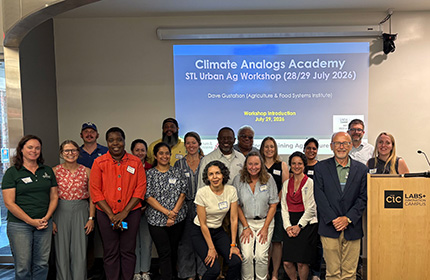
The Agriculture & Food Systems Institute (AFSI), in partnership with Washington State University’s Center for Sustaining Agriculture and Natural Resources and several other partners, held a day-long workshop in St. Louis, Missouri, with a primary overall purpose of developing science-based guidelines for the successful expansion of Urban Ag in St. Louis.
The workshop brought together local and national Urban Ag experts, as well as Specialty Crop Extension specialists from across the country – particularly those in regions now experiencing St. Louis’s future climate (in accordance with the ‘climate analogs’ concept). The workshop also included Urban Ag experts from Dallas and New York City, both of which have seen successful expansion of Urban Ag in recent years.
Background
Pre-Workshop Tour and Reception
The workshop was preceded on July 28 by an optional half-day tour of Urban Ag locations throughout the St. Louis region, including two stops in Illinois: Eckert’s Farm in Belleville and the new Jackie Joyner-Kersee Food, Agriculture & Nutrition (FAN) Center in East St. Louis. A pre-workshop reception was held that evening at the historic Post Building in downtown St. Louis. The reception was highlighted by a moderated panel discussion featuring Maxine Clark (Delmar DivINe) and Elliott Kellner (President, Taylor Geospatial).
Workshop Program
The workshop itself included a morning filled with presentations by several of the gathered experts, followed by a pair of afternoon breakout sessions during which the participants brainstormed opportunities and barriers to the expansion of Urban Ag in St. Louis in two general domains: (1) science-related topics, such as agronomics, climate, and innovative uses of GeoAI; (2) policy-related topics.
Outcomes
Key workshop recommendations were identified in the following areas: research needs, increased funding in Extension and other support areas, strengthened communications, needs for new investments, policy reforms, and the creation of new organizations and branding to support successful expansion of STL Urban Ag. In summary, the workshop participants concluded there are major opportunities for expansion of STL Urban Ag in St. Louis that would bring a host of socioeconomic benefits. Given the current dire status of certain neighborhoods, particularly those ravaged by the May 2025 tornado, action is urgently needed to begin pursuing these opportunities. Fortunately, the St. Louis region possesses the needed expertise and resources to act upon these opportunities. All that is missing is the collective will to begin.
Funding and Acknowledgements
The workshop was organized by Dr. Dave Gustafson under contract with AFSI as a component of the No Cost Extension to the Climate Analogs Academy project, led by Washington State University and funded through USDA NIFA Extension Climate Hub Partnerships Project 2023-67013-39348. Major assistance on workshop planning and execution was provided by Rachel Opitz (Taylor Geospatial).
Key Recommendations
- Conduct and publish an assessment of how climate is likely to impact STL Urban Ag through 2050 and beyond, including the northward movement of pests and diseases.
- Facilitate the creation of a gap analysis and ecosystem map for STL Urban Ag, identifying where resources and research are needed.
- Assess information currently available from groups like City Greens or Local Harvest to determine whether new surveys are needed to learn what crops residents would like to see grown in STL.
- Advocate for the funding of multiple long-term Urban Ag positions in UM/UIUC Extension.
- Explore the St. Louis data dashboard from WashU and assess how to pull demographic and public health data that would assist in STL Urban Ag planning.
- Launch a centralized website for STL Urban Ag: e.g., mapping tool presented by Taylor Geospatial, crops desirability, zoning, resources for farmers, etc. (NYC example)
- Advocate for the development or reinstatement of a clear process/program for accessing vacant land managed by the Land Reutilization Authority (LRA) for Urban Ag in STL.
- Consider encouraging Eckert’s or other investors to launch additional year-round Urban Ag ‘destinations’ in STL, following the practices Eckert’s has pioneered so successfully in nearby Illinois. Collaborate with others already in place (e.g., EarthDance) or currently planning similar initiatives (e.g., Jackie Joyner-Kersee FAN Center).
- Address the massive reforms needed in zoning and other policies to enable successful, rapid expansion of STL Urban Ag.
- Create a new entity (identify optimal host) whose purpose is to facilitate greater cross-sector partnerships on STL Urban Ag, as well as needs in funding and other resources.
- Determine whether a new member-based organization is needed to represent the collective interests of STL Urban Ag farmers.
- Consider creation of a new ‘Grown in The Lou’ sticker/brand for foods produced from crops grown by STL Urban Ag farmers. Collaborate with the similar ‘Known and Grown’ initiative.
- Much stronger and more effective communication is urgently needed to explain how the expansion of Urban Ag and its many benefits should be a critical regional priority.
- Organize a tour for community leaders and policymakers of existing STL Urban Ag sites to showcase success stories and needs.
- Utilize climate-related and other workshop findings, as well as an updated version of the mapping tool to engage a group of current STL Urban Ag farmers and other key stakeholders to co-develop a multi-phased plan for the conversion of current LRA locations into an expanding network of neighborhood-centered urban farms.
- Reconvene the STL-based participants with additional stakeholders working in this space – identify a suitable convener for such a meeting (potentially Danforth, TBC).
Agenda - Day 1
Tuesday, July 28, 2026 | 12:00 pm – 8:00 pm (CT)
| Time | Title/Activity | Presenter/Lead | |
| 12:00 – 5:00 pm | Optional Pre-Workshop Tour | Operation Food Search Community gardens throughout St. Louis Saint Louis University Teaching Garden Eckert’s Farm, Belleville, Illinois Jackie Joyner-Kersee Food, Agriculture & Nutrition (FAN) Center, East St. Louis, Illinois |
|
| 5:00 – 8:00 pm | Welcome Reception at the Post Building | ||
| Moderated Panel Discussion | Lauren Littrell (Moderator) Maxine Clark Delmar DivINe Elliott Kellner President Taylor Geospatial |
Agenda - Day 2
Wednesday, July 29, 2026 | 8:00 am – 4:00 pm (CT)
| Time | Title/Activity | Presenter/Lead | |
| 8:00 am | Welcome & Introductions | Dr. Dave Gustafson Agriculture & Food Systems Institute (AFSI) USA |
|
| 8:30 am | STL Climate Analogs | Kirti Rajagopalan Washington State University (WSU) USA |
|
| 9:15 am | STL Geospatial Analysis | Rachel Opitz Taylor Geospatial USA |
|
| 10:00 am | Break | ||
| 10:15 am | Urban Ag & Specialty Crop Experts From STL and Around the Country | Melba Salazar-Gutiérrez UGA Center for Urban Agriculture USA Yolanda Gonzalez Cornell University USA Micah Anderson Langston University USA Yaritza Torres Espinosa City of Dallas USA |
|
| 12:00 pm | Lunch | ||
| 1:00 pm | Charge to the Breakout Groups | ||
| 1:30 pm | Breakout Session 1: Agronomic & Climate Topics | ||
| 2:15 pm | Break | ||
| 2:30 pm | Breakout Session 2: Non-Agronomic Topics (e.g., Policy) | ||
| 3:15 pm | Re-Gather to Hear Outcomes of the Discussions | ||
| 4:00 pm | Adjourn |
Discover Related Events
-
 Extension Dialogues on Climate Change and Analogs of US Specialty Crop Production
March 1, 2022-March 31, 2022
Pullman, WA, USA
-
-
 Preparatory Webinars for the Extension Dialogues on Climate Change and Analogs of US Specialty Crop Production
January 14, 2022-January 21, 2022
Pullman, WA, USA
-